Change one cue. The rest of the show moves with it.
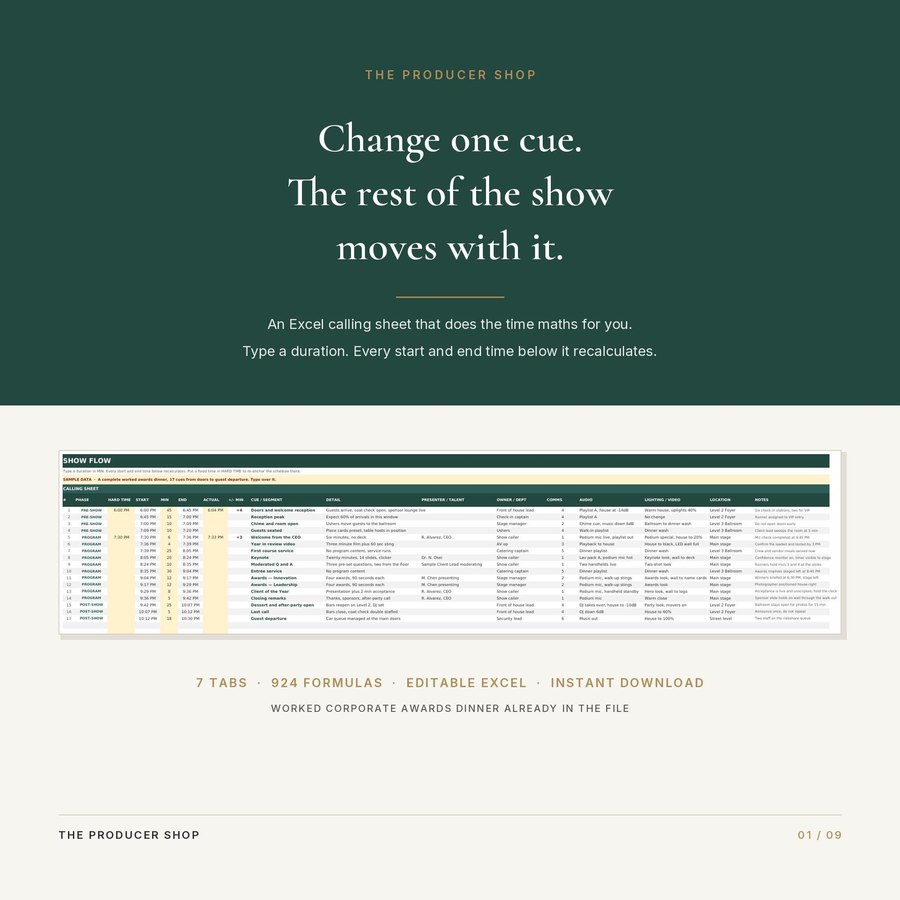
Most run of show documents are a table someone typed by hand. That is fine until four in the afternoon on show day, when the keynote goes from twenty minutes to thirty-five and somebody has to retype every time on the page while the client is standing there.
This one does the arithmetic. You type a duration in minutes and every start and end time below it moves. Change one segment and the rest of the evening shifts with it.
What it is
One Excel workbook, seven tabs, 924 formulas. It covers the show itself, the build and strike day, talent and green rooms, the comms plan and the crew roster, and it audits all of it on a calculated show check tab.
It opens on a complete worked example: a corporate awards dinner with seventeen cues from doors to guest departure, talent, comms channels, audio and lighting notes, and the full load in and load out. You read how it works, then type over it.
The part that matters on show day
Hard times lock what cannot move. Doors at 6:30. Dinner service at 7:15. Enter those as hard times and the schedule re-anchors there instead of drifting.
It tells you when a hard time is impossible. Type a fixed time that lands before the cue above it has finished and the cell turns red and the show check names the cue. It does not block you, because sometimes you need to see the clash before you decide what moves.
You can call the show from it. As each cue happens, type the real time into the actual column. The variance column shows how far ahead or behind you are running, cue by cue, so you know at 8:40 whether you are giving back time or taking it.
It survives midnight. A show that starts at 10:00 PM and ends at 2:30 AM reports a real end time, a real overrun against the end you promised the venue, and a real variance on a cue called at 1:15 in the morning.
The show check is calculated, not typed. Does the program end when you promised. What is the longest segment. How much buffer sits between load in complete and doors. Which cues have no owner, no duration or no comms channel. Which talent entry does not match a cue. It finds the paperwork gaps while they are still paperwork.
Who buys it
Producers who have gone independent and need a calling sheet that belongs to them rather than the one that belonged to their last agency.
Show callers, stage managers and production managers running live programs where the timing is the job.
Agency, brand, venue and in-house corporate teams who need a schedule that holds up when the program changes late.
What you download
One ZIP with three files. The workbook, a short start here guide, and a page explaining what else in the shop overlaps with it so you do not buy the same document twice.
Instant download. Fully editable. Yours to reuse on every event after.
The calculated cells are protected without a password, so a stray keystroke cannot break the formula chain, and everything you are meant to type stays open.
Get the Run of Show Template on Etsy, $18
Start with the free one-page version
Not ready for the full workbook? Drop your email and download the One-Page Event Timeline, free: every segment, owner and status on one sheet.
Professional resources only. No noise. Unsubscribe anytime.
Run of show, answered
What is a run of show?
The minute by minute plan for what happens during an event, in order, with a time and an owner against every cue. It is the document the show gets called from.
Is there a free version?
Yes. The One-Page Event Timeline on this page is free: one sheet with every segment, owner and status. The full Run of Show workbook is $18 on Etsy.
What format is the full template?
An Excel workbook with seven tabs. Start and end times calculate from durations, so one change moves the rest of the show.
Can I use it for corporate events, galas and activations?
Yes. It opens on a worked corporate awards dinner and is built for corporate events, galas, brand activations, conferences and live productions.
What is the difference between a run of show and a production schedule?
A production schedule covers the days around the event, load in to load out. A run of show covers the live program itself, cue by cue. Producers use both.